
How to Check Criminal History in Potter County
Start by naming the question, not the database. A current custody question belongs with the Potter County Sheriff public-record tools. A filed felony belongs with the District Clerk, while a county misdemeanor ordinarily belongs with the County Clerk. The county docket page shows scheduled court activity, but it is not a full case-history index. Texas DPS adds reported statewide conviction and deferred-adjudication data. Each source has a narrow job, and no one result is a complete Potter County criminal record.
Gather the full name, date of birth when lawfully available, spelling variants, case or booking number, incident date, and arresting agency. Compare more than a common name. A booking label can change when prosecutors file charges, and a docket entry can appear after the jail intake. Confirm the disposition with the clerk that holds the Potter County case.
- Choose jail, court, agency report, or statewide history based on the question.
- Search with the best exact identifier, then use a name and date range if needed.
- Check the agency, court, charge, and dates before treating a result as a match.
- Follow the booking entry to the correct Potter County clerk for the filed case and outcome.
- Request a certified disposition or fingerprint personal review when identity or completeness matters.
Potter County's Three Record Systems
Potter County criminal history is split among custody, court, and state reporting systems. The jail roster answers who is held now. The court file shows the charging instrument, hearings, orders, judgment, and sentence. DPS shows public conviction and deferred-adjudication data reported from across Texas. A person can appear in one layer but not another because each layer has different coverage and timing.
The Potter County government home introduces the local offices that divide this work.
That county directory is the practical bridge between a search result and the office that can certify the underlying Potter County record.
Record flow: Arresting agency › Potter County booking › prosecutor and court › Texas DPS reporting.
Official Texas Background Checks
The Texas Department of Public Safety Crime Records Division maintains the Computerized Criminal History system. Its public name-based product releases public Texas conviction and deferred-adjudication information. A name match is not identity proof. DPS warns that name searches can return a different person or miss the intended record. Use the DPS Criminal History Conviction Name Search for that defined public product, then verify local Potter County court events with the proper clerk.
The Texas DPS Crime Records Division describes the repository and its record services.
The state page helps distinguish a public name check from an identity-matched personal record review.
Potter Name Search or Fingerprints
For self-review, fingerprints give the stronger identity match. FAST appointments run through IdentoGO. DPS lists a $15 personal fingerprint criminal-history check plus a $10 FAST capture fee. Two hard cards cost $20, while a law-enforcement agency may charge up to $10 per card. DPS says results may take about ten business days after receipt, excluding mail time. The public online credit price should be checked at purchase; DPS separately states that an offline name search costs $10.
The official IdentoGO FAST enrollment portal supplies current appointment locations rather than relying on a fixed Amarillo vendor address.
That live locator matters because vendor sites and hours can change, while the fingerprint route remains the best way to review one's own Texas record.
| Product | Identity method | Published cost |
|---|---|---|
| DPS offline public search | Name | $10 |
| DPS personal review | Fingerprints | $15 plus $10 FAST capture |
| FAST hard cards | Fingerprints only | $20 for two cards |
Types of Criminal Records
An incident report belongs to the investigating agency and may contain narrative, place, property, evidence, and officer action. The Potter County Detention Center creates the booking file, custody status, bond entry, fingerprints, and photograph. A prosecutor then shapes the formal complaint, information, or indictment. The relevant clerk maintains the court case, while DPS compiles reportable arrest cycles and dispositions. Warrants, supervision files, prison records, and registry listings each have other custodians.
These Potter County criminal records should not be merged into one label. Arrest shows an event, not guilt. Booking shows intake and custody. The court judgment gives the legal outcome. Detailed probation notes are not a public person-search product, though a judgment can show community supervision.
Custody records also split by level. Potter County jail data covers local detention, pretrial custody, short county sentences, and people waiting for transfer. The TDCJ Inmate Information Search covers state-sentenced prisoners, while the federal Bureau of Prisons locator covers federal custody. A Potter County judgment may explain the sentence that led to transfer, but a jail roster will not provide the later state-prison history. The same care applies to sex offender registration: DPS publishes the statewide public registry, while local law enforcement collects and verifies the data for people within its authority.
- Arrest and booking records: agency action, intake, listed charges, bond, and custody.
- Criminal court files: filed charges, motions, hearings, judgment, and sentence.
- DPS history: reported Texas public convictions and deferred adjudications.
- Warrants: court authority tracked by the issuing court and executing agency.
- Supervision and registry records: limited public status information held by the responsible state or local body.
Route Potter County Records Correctly
Downtown court counters and the sheriff complex hold different Potter County records. The county Open Records page says the District Clerk holds district-court files, while the County Clerk holds County Courts at Law records. Sheriff and jail material belongs northeast of Amarillo at the law-enforcement complex.
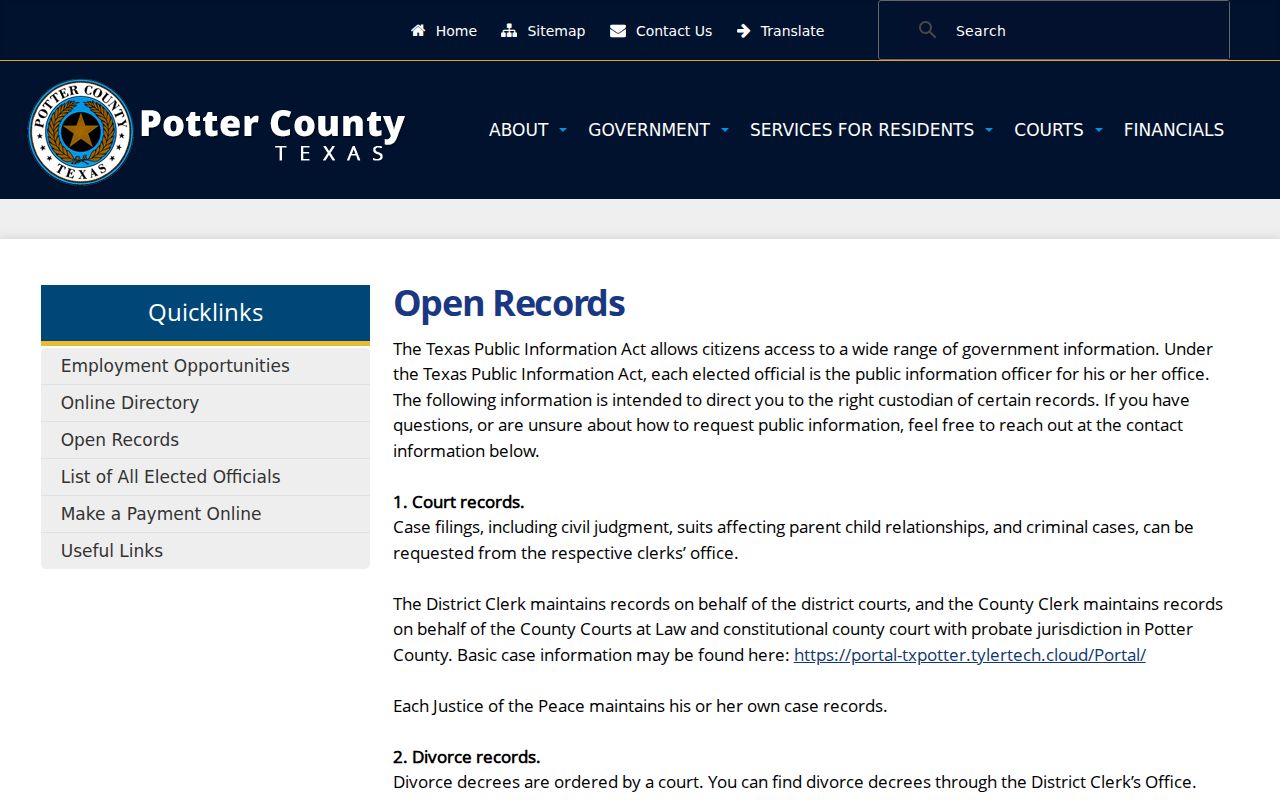
The routing notice prevents a common wasted trip: a clerk cannot supply a sheriff incident report, and the sheriff cannot certify a district-court judgment.
District Clerk
500 S. Fillmore St., Suite 1B
Amarillo, TX 79101
(806) 379-2300
County Clerk
500 S. Fillmore St.
Amarillo, TX 79101
(806) 379-2275 or 2288
Sheriff Records
13103 NE 29th Ave.
Amarillo, TX 79111
(806) 379-2932
Weekdays, 8 a.m. to 4 p.m.
What a Potter County Criminal Record Shows
A full Texas criminal history can connect identity data to arrest cycles, prosecutor tracking, court outcomes, sentences, and custody updates. Public DPS results are narrower. Potter County court files hold more pleadings and event detail, while the jail profile is better for current custody and bond. Read the record type before reading its fields.
Some fields may be redacted. Dates of birth, victim and minor data, government identifiers, medical facts, and restricted documents do not become public merely because a case number appears. Compare the court, agency, dates, and disposition instead of assuming that two name matches describe the same person.
| Name & Identifiers | Names, aliases, birth data, and repository or booking identifiers where public. |
|---|---|
| Arrest / Booking Data | Agency, arrest and booking dates, listed charges, bond, and release status. |
| Charges & Statutes | Complaint, information, or indictment text and the cited Texas law. |
| Disposition | Dismissal, acquittal, conviction, deferred adjudication, or another outcome. |
| Sentence | Jail or prison term, fine, restitution, and community-supervision conditions shown in court. |
| Custody / Supervision | Local jail, TDCJ, release, parole, or court-ordered supervision status when public. |
Potter County Jail Record Context
The Potter County Detention Center was completed in November 1995. One official description lists 576 general beds, a 27-bed infirmary, and two violent cells. The divisions page gives a 599-person total divided among male, female, and medical spaces. Preserve both counts because they appear to classify special areas differently. The sheriff reports roughly 500 to 520 people housed daily, and Potter County conducts magistration each day at 11 a.m.
The official detention-center page provides the facility history and custody details.

The image supports an important limit: a roster is a present custody snapshot, while the Potter County criminal court file supplies the later disposition.
Public Access Laws
The Texas Public Information Act governs access to local executive records, subject to exceptions. Court files follow judicial access and sealing rules, so a clerk request should not be treated as an ordinary sheriff TPIA request. Texas criminal-history law keeps broad CHRI confidential while authorizing DPS to release the defined public conviction and deferred-adjudication product. Ask the body that created or keeps the record.
Key Statutes:
Government Code Chapter 552 governs public requests to Texas agencies and local bodies.
Government Code Chapter 411 controls criminal-history access, public release, and nondisclosure.
Code of Criminal Procedure Chapter 66 sets the criminal-history reporting chain.
Code of Criminal Procedure Chapter 55 governs qualifying expunctions.
A narrow request works best. Give the incident or case date, agency, place, person, report or case number, and exact record sought. Ask for a cost estimate when charges may exceed the amount you are prepared to pay.
Potter Sheriff Records Fallback
When the online roster, Book In's log, or warrant list does not answer the question, the Sheriff's Records Department provides an in-person route. A requester appears at 13103 NE 29th Avenue, completes the office form, and presents picture identification. The counter is open Monday through Friday from 8 a.m. to 4 p.m.; questions go to (806) 379-2932. No complete official copy-fee schedule or promised turnaround was found.
The Potter County Sheriff home leads to these local tools and services.

The sheriff source makes the fallback concrete: describe the incident, date, place, person, report or booking number, record type, and preferred copy format.
Sealed, Expunged & Restricted
Juvenile information, certain victim and minor identifiers, confidential criminal-history data, medical detail, and active-investigation material may be withheld or redacted. Expunction and nondisclosure are distinct Texas remedies. Chapter 55 expunction can remove qualifying arrest records under defined outcomes and limits. Nondisclosure restricts ordinary public release for eligible cases but preserves access for authorized government users.
In Potter County, identify the court, obtain a certified disposition, and use the court authorized by statute. A dismissal alone does not prove eligibility. All agencies holding a covered record must be addressed as the law requires. If DPS merely lacks a disposition, supply a certified court copy through its correction route instead of assuming expunction is needed.
Processing extends beyond the judge's signature. The clerk, prosecutor, arresting agency, Potter County jail, and DPS may each hold a covered copy and need time to carry out an order. Review the fingerprint-based personal record and local court visibility afterward. Nondisclosure is not destruction; authorized agencies can retain access. Eligibility depends on the arrest, offense, outcome, waiting period, and other statutory limits, so a short online docket label cannot settle the question.
Fix a Potter Disposition Gap
DPS says its system depends on reports from Texas criminal-justice agencies. A Potter County arrest cycle may therefore lack its court outcome. Start with a fingerprint-based personal review to confirm the identity match. Then request a certified disposition from the court of jurisdiction. DPS requires the certified court document, not an ordinary photocopy without the court's embossed seal.
The Texas conviction search entry shows the public product used for statewide reported results.
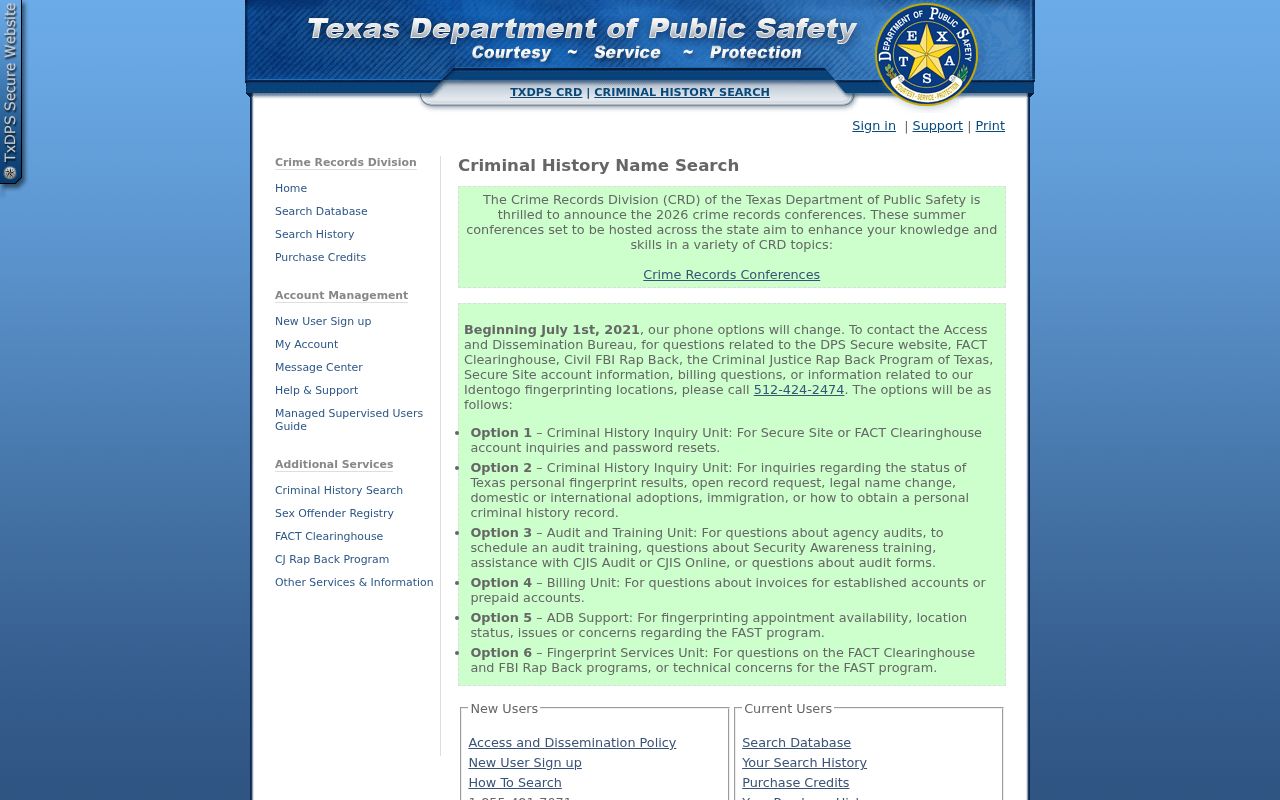
A public name result should be treated as a lead. The Potter County clerk's certified judgment remains the source for correcting the missing outcome. The DPS Crime Records contact page supplies the current bureau channels for a Texas record question.
Potter County Warrant Record Split
The Potter County Sheriff publishes an Active Warrants list, but its FAQ says warrant information is not given by phone. Use the official list or appear at the warrants section. Amarillo Municipal Court runs a separate city warrant tool, and its current notice says the list is not updating. That court directs verification to (806) 378-3082. Do not treat a city warrant as a county felony warrant, and never approach a wanted person.
The official county directory identifies the offices responsible for local justice records.
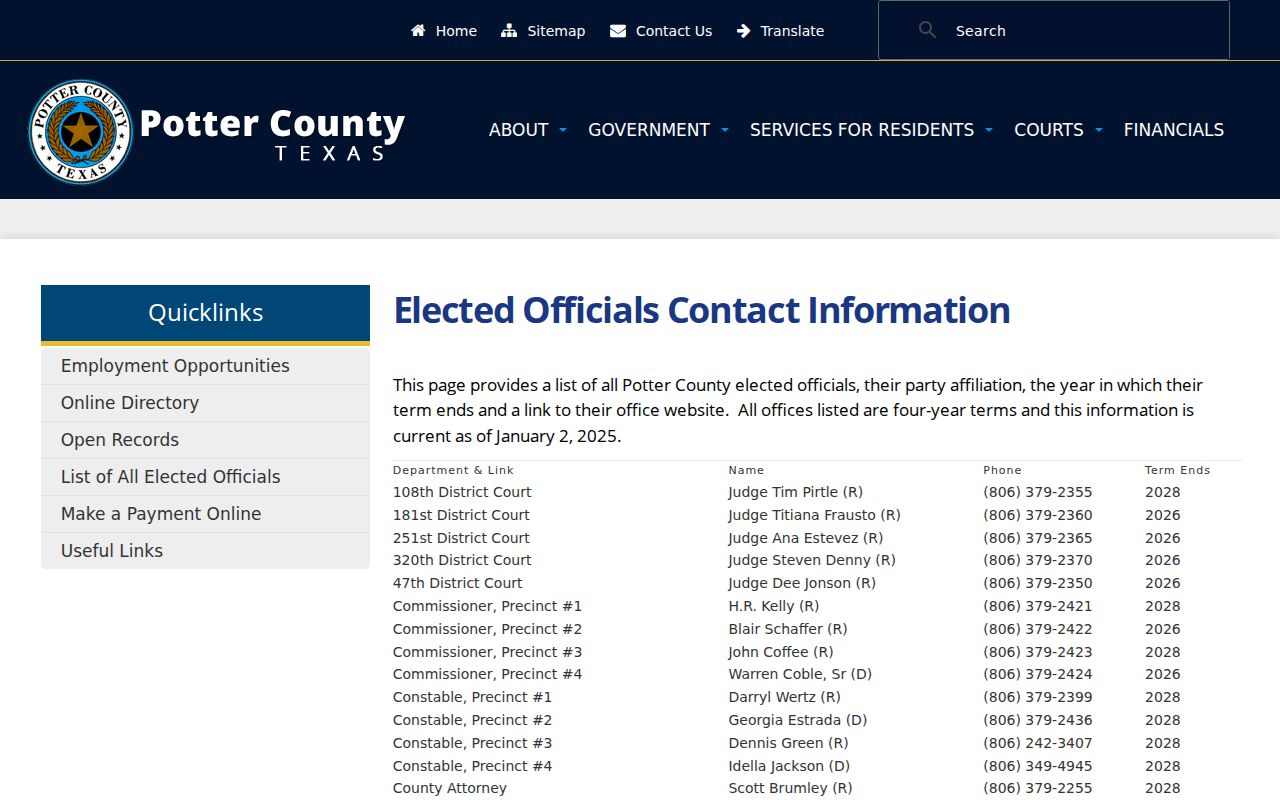
Use the issuing court and agency named on the record, since sealed, juvenile, new, or recently cleared warrants may not appear online.
Potter County also publishes warrant-deputy numbers for operational contact and tips, but those listings do not cancel the sheriff FAQ's refusal to verify personal warrant status by phone. A person resolving an own warrant should use the official online or in-person channel, the issuing court, or counsel. For a municipal matter, current Amarillo rules and fees belong to the city court. For a county or district matter, the court named on the warrant controls. This distinction protects against paying or appearing at the wrong office.
Potter County Record Terms
Short docket labels can hide major differences. These terms help connect a Potter County booking entry to the later criminal case without guessing about the result.
- Magistration
- The prompt hearing for warnings, probable cause, and bond.
- Indictment
- A grand jury's formal felony accusation.
- Disposition
- The outcome of a charge or case.
- Deferred adjudication
- A deferred finding during community supervision; it is not the same as conviction.
- Nondisclosure
- A Texas order limiting public release while preserving authorized access.
Read these terms in the dated docket sequence. A charge can be filed, changed, dismissed, or resolved later, so one isolated label rarely tells the whole Potter County criminal history.
Criminal Records by City in Potter County
Potter County has only two incorporated places. Amarillo spans Potter and Randall Counties, so confirm the incident location, booking jail, and court before searching. Bishop Hills has no separately documented police records office or municipal court in the official sources reviewed; its residents route incidents and most record questions through Potter County agencies.
An Amarillo Police Department report stays with APD even when the person was booked into Potter County jail. The later case may go to Amarillo Municipal Court, a County Court at Law, or a Potter district court based on the offense and venue. Bishop Hills matters use county, district, or justice-court routes rather than Amarillo's city portal. The arresting agency, report header, booking facility, and issuing court are more reliable routing clues than the place name alone.
Amarillo Criminal History
APD holds its reports, while the city court and Potter County clerks hold separate case files.
Bishop Hills Criminal History
The sheriff, county courts, district courts, and justice courts supply the relevant routes.